Why Your Garage or Shop Still Floods (And How Concrete Fixes It)
Garage or shop still flooding even after new door seals? The real problem is usually your concrete and drainage. Here’s how we diagnose and fix it for good.
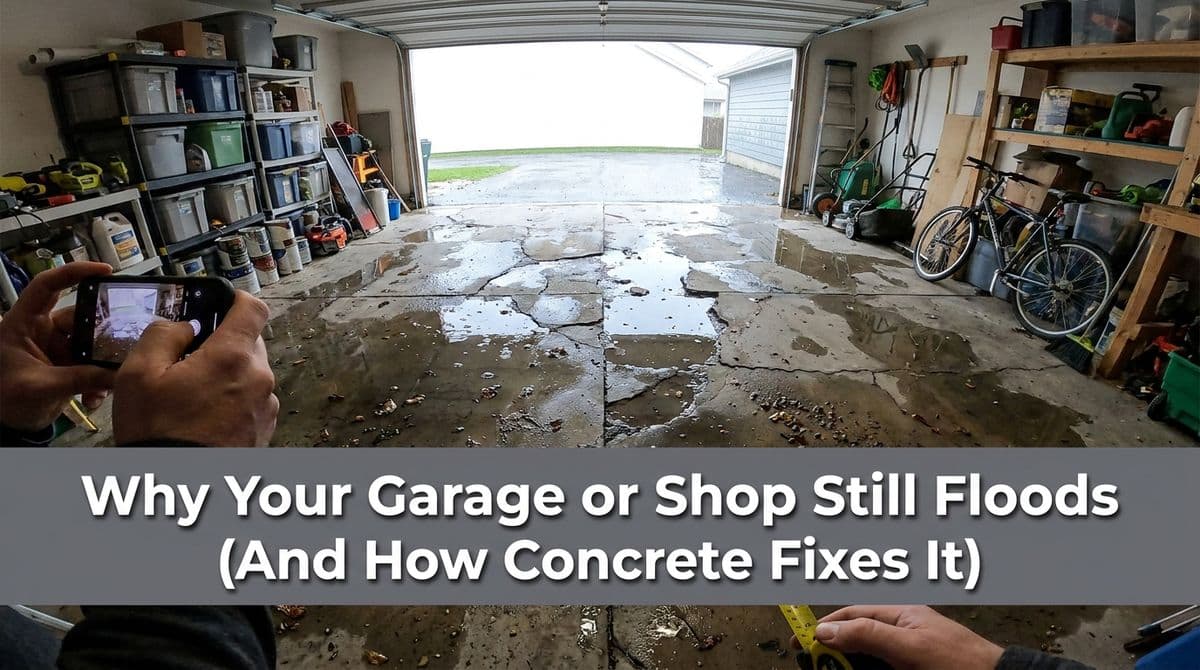
"I Just Put New Door Seals On… Why Is My Shop Still Flooding?"
We recently got a call from a customer — let’s call her Lisa — who was at her wit’s end with a flooding shop. She has a large three-bay building, and every decent rainstorm was sending water straight under the doors and across her floors.
Lisa had already done what most homeowners do first: she installed brand-new rubber seals under each overhead door. Two doors, fresh seals… and it still didn’t help. After a recent storm, the smallest bay — the one she’d turned into a craft and hobby room with new flooring — was soaked.
When I pulled up her property on the map while we talked, I could already see one big clue: a noticeable slope coming down toward the shop from the road and driveway. In other words, gravity was working against her before the first raindrop ever hit the ground.
Why Door Seals Alone Don’t Stop Garage or Shop Flooding
It’s natural to assume that if water is coming under the door, the door must be the problem. But in most cases we look at — including Lisa’s — the seals are just the last weak point in a bigger drainage and concrete issue.
Here are the most common reasons your garage or shop floods even with new door seals:
- The driveway slopes toward the building. If the concrete or asphalt is pitched toward the doors instead of away from them, every storm turns that driveway into a ramp delivering water straight to the opening.
- The slab at the door has settled. Over time, the concrete right at the doorway can sink, creating a little "birdbath" where water collects and then pushes under the seal.
- No place for water to go. If there aren’t any drains, swales, or channels to redirect runoff, water will always choose the lowest path — often right into your shop.
- Seals can’t hold back standing water. Door seals are designed to stop splashes and light runoff, not to act like a dam against pooled water that’s sitting and building pressure.
In Lisa’s case, the driveway was bringing water down the hill, and a slight low spot at the shop doors was acting like a catch basin. The seals just couldn’t compete with that.
Step One: Diagnose the Real Source of the Water
When we meet customers like Lisa, our first job isn’t to sell a product — it’s to figure out exactly how the water is moving. If you’re trying to do some detective work at home, here’s how you can start:
- Watch during a storm. Safely step out under cover and actually watch where the water flows. Is it coming down the driveway like a river? Sheeting off the roof in one spot? Running along the side of the building?
- Look for staining and debris lines. After things dry out, check for dirt lines, leaves, or discoloration on the driveway and at the threshold. Those often map out the water path.
- Check the slope. A simple level or even a marble on the driveway can tell you which way things are pitched. If the level bubble or marble heads toward your shop, that’s a red flag.
- Inspect the concrete at the door. Look for gaps under the seal, low spots holding water, or cracks that may be channeling water inward.
The best long-term fix will always depend on this diagnosis. That’s why we told Lisa the same thing we tell most callers in her situation: we need to come out and put eyes on it.
Concrete Repair & Drainage Solutions That Actually Work
Once we understand the water pattern, there are several concrete-related solutions we can use. In many shops and garages, a combination of these is what finally stops the flooding.
1. Re-establishing Proper Slope
If the driveway or the slab at the door pitches the wrong way, we can often correct it using concrete lifting (sometimes called slabjacking or polyjacking). By injecting material under the slab, we can gently lift and tilt the concrete so it sheds water away from the doors instead of toward them.
This can:
- Eliminate low spots and puddling at the threshold
- Help the door seals make proper, even contact
- Reduce the volume of water reaching the building in the first place
2. Installing a Trench Drain at the Door
For properties like Lisa’s — where a hill or long driveway sends a lot of water toward the building — a trench drain cut into the concrete right in front of the doors can be a game changer.
We saw-cut a narrow channel, install a drain body and grate, set it to the right height and slope, and tie it into a safe discharge point (like a daylight outlet or drainage line). Instead of slamming into your door seals, water drops into the grate and is carried away.
3. Raising or Resurfacing the Threshold Area
If the area right at the threshold has settled or worn down, we can sometimes raise or resurface that specific strip of concrete to create a gentle hump. That small change helps:
- Give door seals a solid, continuous surface to press against
- Act as a mini speed bump for incoming water
- Direct light runoff to the sides instead of straight in
When combined with good seals and proper drainage, this can be very effective — especially for converted spaces like Lisa’s craft room, where even a small amount of water is a big problem.
Simple Things Homeowners Can Check Before We Arrive
While most flooding issues need a concrete or drainage fix, there are a few quick checks you can do on your own:
- Gutters and downspouts: Make sure gutters aren’t dumping tons of water right at the corners of your shop or garage. Add extensions if needed.
- Debris at the door: Leaves and gravel can keep the seal from sitting flat. Sweep the threshold and check for gaps with a flashlight from inside.
- Door alignment: A door that’s out of level or out of track may not compress the seal evenly. Sometimes a door service technician and a concrete repair crew need to tag-team the fix.
If you’ve already tried seals and still have water coming in — like Lisa did — chances are the problem is bigger than a strip of rubber. That’s where we come in.
When It’s Time to Call a Concrete Pro
Anytime you’re seeing repeated flooding, damaged flooring, or you’re using a bay as finished space (craft room, home office, storage for valuables), it’s worth getting a professional look at the concrete and drainage around your building.
We’ll do the same thing we did for Lisa: walk the site, look at slopes and low spots, watch (or simulate) how water moves, and then lay out practical options — from concrete lifting to trench drains — that match your budget and how you use the space.
If your garage or shop keeps flooding even after new door seals, it’s not that you did something wrong — it’s that the real problem is in the concrete and drainage, not the rubber. Fix that, and you can finally stop mopping and start using your space the way you intended.